Cloudy Hot Water? The Simple Glass Test Every Winnipeg Homeowner Should Know
Milky hot water that clears from the bottom up is usually just air. Here is how to tell harmless cloudiness from sediment, rust, and the signs worth a service call.
Author : Lidoma Home Services Ltd
You fill a glass from the hot tap and the water comes out looking like a weak, milky fog. It is an unsettling little moment - is this the tank failing, the city supply, or something worse?
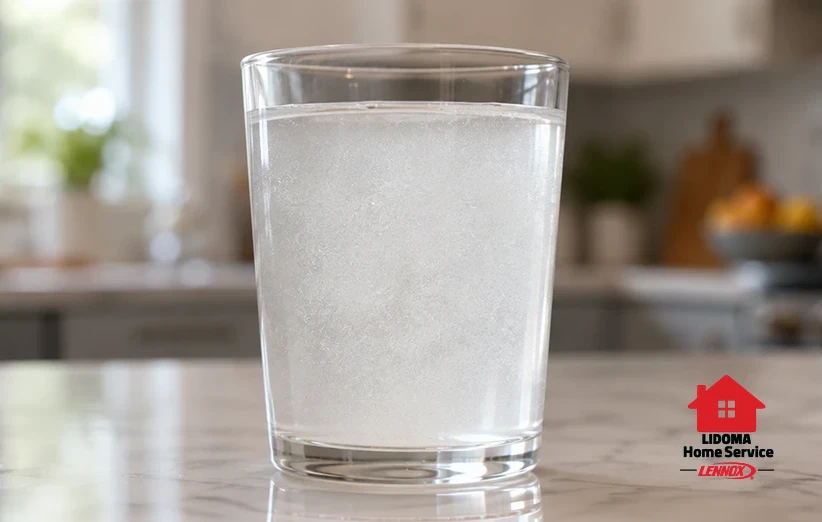
The reassuring truth is that cloudy hot water is usually exactly what it looks like and nothing more: air. Water in your tank and pipes holds dissolved gases, and hot water under pressure holds even more. Draw it into the open air and the pressure drop releases the gas as millions of micro-bubbles, which scatter light and read as white or milky. It is the same physics as fog on a lake.
But not all discoloured water is harmless air, and Winnipeg homeowners have a genuinely reliable way to tell the difference in under a minute - plus a short list of signs that mean the tank, not the water, needs attention.
One glass, one minute, real answer
Fill a clear glass from the hot tap and set it on the counter. Watch what happens. If the cloudiness clears from the bottom of the glass upward - bubbles rising and popping as they release - the water is simply air-saturated, and it is completely safe. If the cloud does not clear, or the colour settles toward brown, rust, or grey sediment at the bottom, the water is carrying something that will not evaporate, and the source needs to be found.
If the test points to your tank - rusty water, persistent sediment, or cloudiness that never clears - Lidoma Home Services diagnoses and services hot water tanks across Winnipeg, Manitoba.
Why hot water is cloudier than cold
The cloudiness asymmetry between your taps has a simple explanation: temperature changes how much dissolved gas water can hold, and heating pushes dissolved gases out of solution. Water sitting in the tank and hot-water lines is warmed and slightly pressurized; the moment it exits the tap, it can carry less gas, and the excess comes out as micro-bubbles.
You will notice it most at fixtures far from the tank, after the water heater has just finished a heating cycle, and in winter - cold incoming water holds more dissolved gas to begin with, so the effect strengthens when the ground around the service line drops toward freezing.
New tank installations also produce a stretch of extra-cloudy water. The system has just been refilled, the plumbing has been worked on, and the lines are temporarily loaded with air. It settles out over days of normal use.
The colours that mean something different
Cloudy white is air. Other colours carry other messages. Rusty, reddish, or brownish hot water - especially when the cold tap runs clear - points to corrosion inside the hot water tank or the hot-water piping. In the tank, that story usually begins with a spent anode rod, the sacrificial component designed to corrode before the tank lining does.
Grey or dark particles that settle in the glass are sediment: mineral scale and debris from the tank bottom being stirred up and carried out. A white or bluish-green crusty buildup around fixtures and fittings is mineral scale from hard water, which affects fixtures and appliances but is not the tank failing.
Each of these has its own next step, and the step is rarely 'keep watching' - rusty water from a mature tank and sediment shedding from the bottom are both tank-end-of-life or tank-maintenance conversations.
When the tank is the source (and when it is not)
The hot-only versus both-taps comparison is the fastest source test in plumbing. If only the hot side is affected, the problem lives between the tank and the taps - most often the tank itself. If cold water shows the same colour or cloudiness, the source is upstream: the municipal supply doing maintenance nearby, the service line, or the household plumbing generally.
City-side disturbances are real and temporary: water main work and hydrant flushing push discoloured water through neighbourhood lines for hours at a time. Running a cold tap until it clears resolves those. Persistent discolouration on both sides is a different matter and worth reporting.
Homes on private wells outside the city live with a broader water-quality menu entirely, and sediment or iron issues there are water-treatment questions as much as tank questions - worth raising with a technician so the tank discussion does not absorb blame that belongs upstream.
What a tank check covers when the glass test fails
When the water points at the tank, a service visit follows a short, logical sequence: the tank's age and history, the anode rod's condition, a flush of the sediment at the bottom, and an inspection of the fittings and relief valve. Sometimes the answer is a spent anode and a flush - genuine maintenance that buys years back. Sometimes it is a tank whose lining has already turned the corner, and the honest recommendation is replacement before a leak makes the decision.
The glass test is worth remembering even after this particular episode passes. Water colour is the one gauge of tank health that requires no tools, and checking it a couple of times a year - especially as the tank ages - catches problems while they are still small ones.
If your hot water has stopped passing the test, Lidoma Home Services provides hot water tank diagnosis, repair, and replacement across Winnipeg.