Humidifiers and Mold in Winnipeg Homes: Finding the Winter Humidity Balance
Winnipeg winters pull indoor air bone dry, but pushing humidity too far the other way invites condensation and mold. How to find the balance for your house.
Author : Lidoma Home Services Ltd
Every Winnipeg winter runs the same seesaw. The heating season dries the house out - static shocks at every doorknob, creaking floors, dry throats in the morning - and a humidifier looks like the obvious cure. Then January arrives, the humidifier runs hard, and condensation starts weeping down the windows. Push humidity far enough for long enough, and the condensation stops being a window problem and becomes a mold problem on cold surfaces: frames, sills, and the corners of exterior walls.
So homeowners are stuck between two genuine problems. Too little humidity is uncomfortable and hard on the house itself. Too much quietly grows mold in the places you notice last. The answer is not choosing a side - it is understanding that the right humidity level moves with the weather, and that the house itself tells you where the line is.
Here is how to read those signals, and how a properly sized and maintained whole-home humidifier keeps you on the comfortable side of the line without crossing into mold territory.
Get the humidity right for your house, not a chart
Every home's balance point is a little different - insulation, window quality, and how airtight the building is all move it. Lidoma Home Services installs and services whole-home humidifiers across Winnipeg, Manitoba, and a properly set up system takes the guesswork out of the season. If your windows are sweating or your home is still dry with the humidifier running, that is the visit to book.
Why Winnipeg houses dry out so completely
Cold air cannot hold much moisture, and a January air mass in Manitoba holds almost none. When that air is drawn into the house and heated to room temperature, its relative humidity collapses - the same absolute moisture, spread across much warmer air, reads as desert-dry on the hygrometer.
The furnace then recirculates that dry air continuously, and every bit of moisture the house generates - showers, cooking, breathing - is pulled away by the same furnace airflow and by any air leakage to the cold outdoors. Older homes leak so much air that they partially dry themselves; newer, tighter homes hold their moisture better and need less humidification than their owners expect.
That is the first useful insight: the dryer the outdoor air and the tighter the house, the more precise your humidity management needs to be. A humidifier running at one fixed setting from November through March will be right some weeks and wrong others.
The dry side: what too little humidity costs
Under-humidified winter air announces itself through the people in the house first: dry skin and cracked lips, scratchy throats, static electricity that makes every door handle a small event. Wooden furniture, flooring, and instrument bodies react too - gaps open up in hardwood boards and trim as the wood gives up its moisture.
The house itself suffers in less obvious ways. Repeated seasonal swings between bone-dry and humid air stress wood joinery and paint. Gaskets around doors and windows last longer in stable conditions.
And there is the comfort paradox worth knowing: air that feels chilly at low humidity feels warmer at proper humidity, at the same thermostat setting. Households that humidify sensibly often find themselves nudging the thermostat down a notch, not up.
The wet side: how mold actually gets started
Mold needs moisture and a surface, and in a Winnipeg winter the moisture appears exactly where the house is coldest: window glass and frames, exterior wall corners, the ceiling edge of outside walls, behind furniture pushed up against those walls. Warm indoor air carries water vapour; when it touches a surface cold enough, the vapour condenses into a thin, persistent film - and that film is mold's starting condition.
The progression is predictable. First fogging on the windows in the morning. Then persistent condensation that pools on sills. Then dark speckling at the corners of the frame, or a musty smell in a room that never quite airs out. By the time mold is visible, the humidity has been past the house's limit for a while.
Closets and exterior corners deserve special suspicion: enclosed, cooler, and low-airflow is precisely where condensation problems develop unnoticed. Moving furniture a few inches off exterior walls for the winter is free prevention.
Reading your house: condensation is the gauge
Hygrometers help, but the most honest gauge in a Prairie winter is your own windows. A little morning fog that burns off by mid-morning is normal in deep cold. Condensation that lingers all day, collects in the bottom tracks, or appears on walls means the humidity has crossed what your house can hold - and the setting needs to come down, whatever the number on the device says.
That is because the safe humidity level genuinely moves with the weather. The colder it is outside, the colder your window glass and exterior walls run, and the less indoor moisture they can tolerate before condensing it. A level that is comfortable and safe in a mild November week can grow mold in a late-January cold snap at the exact same setting.
A whole-home humidifier with a proper humidistat handles this automatically, modulating with outdoor conditions. Portable units rely on the homeowner to walk around and turn them down - and it is usually the forgotten one in the bedroom that grows the January mold.
Maintenance keeps the humidifier part of the solution
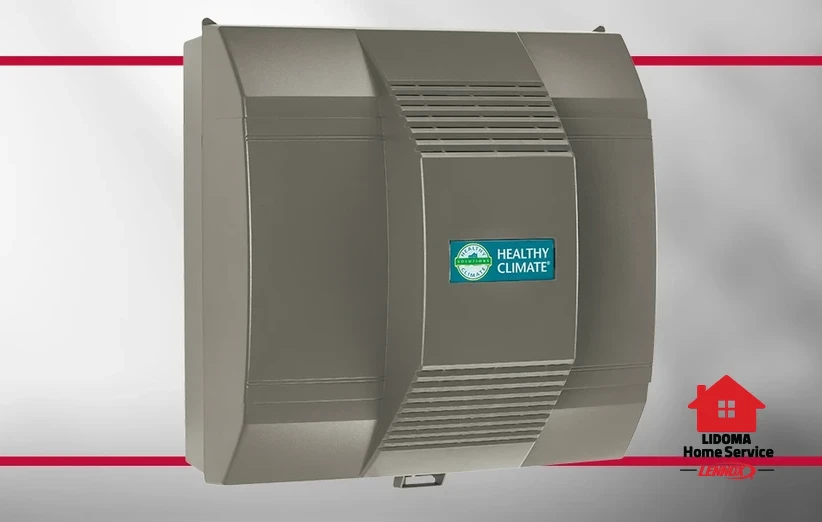
A whole-home bypass or fan-powered humidifier mounts on the furnace duct and feeds moisture into the warmed airflow - but its water panel (the evaporative pad) is a consumable. Left in season after season, it crusts with mineral scale, stops evaporating evenly, and can become exactly the kind of damp, neglected surface the whole article is about avoiding.
Seasonal discipline is simple: fresh pad at the start of the heating season, water feed and drain checked, humidistat set sensibly, and everything shut down and drained for the summer so no water sits in the saddle valve and line through a humid July.
Done that way, a whole-home humidifier holds the comfortable middle all winter - no nosebleeds, no static, and no condensation gardens on the window frames. If your system needs setup, a pad replacement, or an honest assessment of why one room stays dry, Lidoma Home Services maintains humidifiers across Winnipeg through the heating season.