Boiler Circulator Pumps: A Winnipeg Homeowner's Guide to Heat That Won't Move
What a circulator pump actually does, the noises and cold symptoms that point to it, and what a fall heating check should include.
Author : Lidoma Home Services Ltd
Winnipeg is furnace country, there is no arguing that. But if you live in one of the city's older character homes, a converted duplex, or a house with radiators or in-floor loops, you have a boiler quietly doing the heating work - and a circulator pump making the whole system possible.
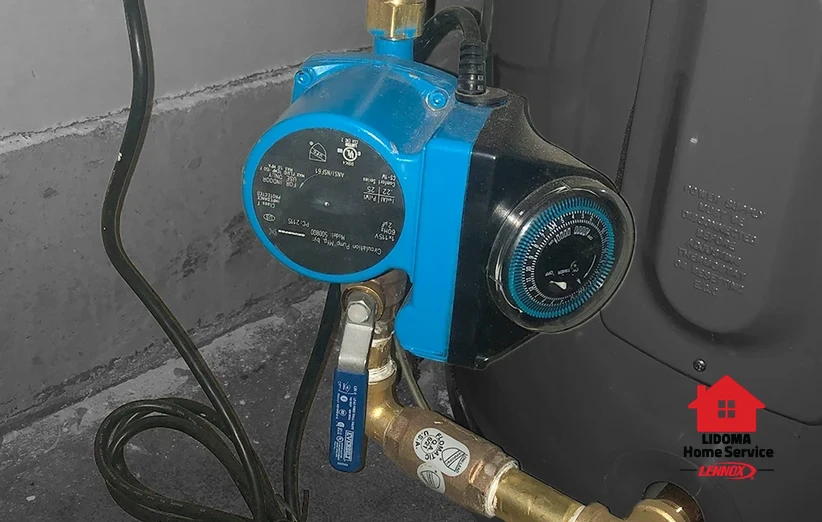
The circulator pump is a small motorized unit, usually found near the boiler, that pushes hot water through the piping loop and back again. When it works, heat arrives evenly and the system feels calm. When it struggles, the symptoms are oddly specific: some radiators or loops stay cold while others get hot, the pump hums or rattles louder than usual, or the boiler short-cycles because heat is not moving away from it fast enough.
Because these symptoms are easy to mistake for thermostat trouble or a boiler problem, a lot of homeowners live with a weakening pump for weeks before anyone looks at it. And a Winnipeg October is a bad time to find out your heating loop depends on a part that has been failing quietly since spring - the first hard freeze of the season is exactly when a marginal pump gives up.
If your home runs on a boiler, it is worth understanding what this little component does and what a technician actually checks when they inspect one.
Book a heating-system check before the cold settles in
Lidoma Home Services maintains heating systems across Winnipeg, Manitoba through the cold months. If your system is not keeping up, book a visit through our furnace and heating tune-up service page or call +1 204 297 4420.
What the circulator pump does in a hydronic loop
A boiler heats water; it does not push it anywhere on its own. Gravity and pressure alone cannot move water quickly enough through the pipes, out to your radiators, in-floor loops, or baseboard fin tubes, and back to the boiler to be reheated. The circulator pump is what keeps that loop moving at a steady rate.
Most residential pumps are a compact sealed unit with an electric motor and an impeller. Water enters one side, is spun outward by the impeller, and exits toward the piping circuit. The whole assembly is designed to run for years with very little attention, which is exactly why homeowners rarely think about it until it starts to fail.
Flow rate matters more than most people realize. Too little circulation and the furthest rooms in the house never warm up, no matter what the thermostat says. The boiler, meanwhile, can keep firing into water that is not moving away fast enough, which is hard on the unit itself.
The symptoms Winnipeg homeowners notice first
A failing circulator almost always announces itself through the rooms rather than the boiler. The classic pattern is uneven heat: the radiator closest to the boiler gets hot while the one at the far end of the run stays lukewarm, or one bedroom loop warms up long after the rest of the house. In homes with zones, an entire area can go cold while the rest of the house behaves normally.
Sounds are the second clue. A healthy pump is barely audible. A grinding or rattling noise points to worn bearings, a humming pump that never seems to move water suggests a seized impeller, and knocking that starts when the heating kicks on can mean trapped air the pump is fighting against.
The third clue shows up on the boiler itself. If heat is not being carried away quickly, the boiler can reach its limit temperature quickly and shut off, then fire again a short time later. That short-cycling pattern, repeated over days, is worth treating as a circulation question rather than a boiler failure.
Air in the lines after a long summer shutdown
In Winnipeg, hydronic systems typically sit idle from late spring through September. During those months, small amounts of air can work their way into the piping - through fittings, automatic air vents, or during any water top-up. When the system restarts in autumn, that air shows up as gurgling and trickling sounds, cold spots at the top of radiators, and a pump that runs noisily because air pockets break up the water flow it is trying to move.
Bleeding air at the radiators and checking the system pressure is standard start-of-season work. If the loop was drained for any renovation over the summer, the refill and purge process matters even more, because a partially purged loop will circulate poorly for weeks.
This is also why the first week of heating season is the most revealing time of year for a hydronic system. Any weakness that developed over the summer shows itself right away.
Wear, seals, and the parts that fail
Circulator pumps fail in a few predictable ways. The motor windings can burn out, usually noticed as a pump that is silent when it should be running. Bearings wear down over years of continuous rotation, first as noise and eventually as enough play to stall the impeller. On some designs, the coupling between the motor and the impeller shaft cracks or slips, so the motor spins happily while nothing moves.
Leaks around the pump body are another late-stage sign. Weeping seals leave mineral marks or dampness on the floor below, and in a mechanical room that already hosts the boiler and domestic plumbing, a slow drip is easy to miss until it has been there for a season.
The good news is that a circulator pump is one of the more straightforward components to replace in a hydronic system, and a matching replacement does not require touching the boiler itself. The important part is diagnosing the pump honestly rather than assuming the boiler is at fault.
What a fall heating check should include
Whether your home is heated by a boiler or a furnace, the value of a seasonal check is the same: find the component that is about to let you down in January, while it is still a five-minute conversation in October instead of an emergency call at minus thirty.
For a hydronic system that means listening to the pump under load, confirming water pressure, bleeding air where needed, and watching the boiler cycle normally. It is the same discipline Lidoma Home Services applies to forced-air heating: look at the whole system, not just the appliance in the middle of it.
If your circulator pump is already noisy, if some rooms have given up on getting warm, or if the boiler is cycling in a way it never used to, that is your cue to have it looked at before winter commits. The heating tune-up and repair team at Lidoma Home Services serves homeowners across Winnipeg, Manitoba.